
1MHG (Message Header Group)
The 1MHG (Message Header Group) is the very first structural group that appears before any transaction in an AL3 message. Its primary functions include:
1. Logical Message Start
It defines the beginning of a message, acting as a marker for systems to recognize when a new message transmission begins.
2. Addressing on an Agency-Company Basis
The 1MHG contains essential routing data, such as agency and carrier identifiers, which ensures that all subsequent transactions in the message are directed to the correct recipient. It enforces the rule that each message must contain transactions for only one recipient..
3. Support for Logical and Physical Communications
The 1MHG includes fields needed by:
- Physical communication partners (e.g., communication protocols and session-level identifiers)
- Logical business partners (e.g., agencies and carriers conducting the actual insurance business)
Importantly, the fields in 1MHG are protected from alteration. Intermediaries like Value-Added Networks (VANs) must not modify these fields—they must pass them along intact to the ultimate logical receiver to preserve message integrity.
Mandatory elements of 1MHG
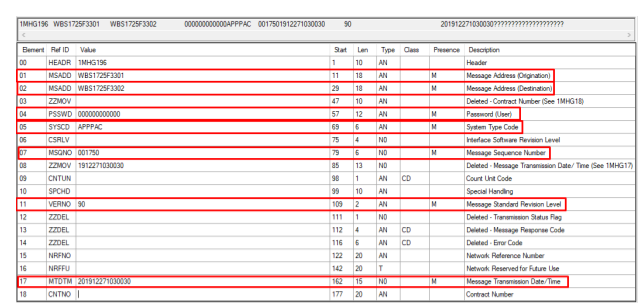
- Message Address (Origination): The Machine Address portion of the Message Address (Origination) is a key logical and physical element in the Message Header Group. It must be passed unchanged from the logical sender to the logical receiver. It serves as the return address for replies at both the message and transaction levels, becoming the Message Address (Destination) for responses.
Structure:
The data length of this field is 18 characters.
Machine Address Portion: 12 characters — 3-character Network Prefix, 3-character Area Code, and 6-character Originator Code. Identifies the originating machine.
Subaddress Portion:6 characters — 4-character Participant Code and 2-character Office Number. Used when the receiver cannot be uniquely identified by Machine Address alone (e.g., branch offices or shared systems).
For Example: WBS1725F3301 - Message Address (Destination): The Machine Address portion of the Message Address (Destination) is a key logical and physical element in the Message Header Group. It must be passed unchanged from the logical sender to the logical receiver. It serves as the return address for replies at both the message and transaction levels, becoming the Message Address (Destination) for responses.
Structure:
The data length of this field is 18 characters
Machine Address Portion: 12 characters — 3-character Network Prefix, 3-character Area Code, and 6-character Originator Code. Identifies the originating machine.
Subaddress Portion: 6 characters — 4-character Participant Code and 2-character Office Number. Used when the receiver cannot be uniquely identified by Machine Address alone (e.g., branch offices or shared systems).
For Example: WBS1725F3302 - Password (User): The User Password is used to confirm that the sender is allowed to send messages to the receiver. The “000000000000” cannot be assigned as a private password because it is considered a public password.
- System Type Code: This code is chosen by each user to identify the specific system they’re using for their communication session. Examples include APPPAC, POLDEC or any other code that clearly represents the user’s system setup.
- Message Sequence Number: It is a control count that increases by 1 for every message sent between two physical machines, helping ensure no messages are missed. The data length of this field in the AL3 is 6 digits, ranging from 999999 to 00000l. Zero is not a valid Message Sequence Number.
- Message Standard Revision Level: It indicates the revision level of the transaction structure standard used.
- Message Transmission Date/Time: This element shows the exact time the message was sent from the system that created it.
The format is YYYYMMDDHHMMSSS, where: YEAR, MONTH, and DAY are mandatory. However, the hours, minutes, and seconds are optional.
SAMPLE SCREENSHOT OF 1MHG Group:
3MTG (Message Trailer Group)
The Message Trailer Control Group comes right after the last transaction in a message. It shows that the message has ended and helps check if it was sent correctly. The receiver must verify the character or element count to make sure nothing is missing or wrong.
Sometimes, there’s a need to send System Messages — these are not regular insurance transactions but short messages meant to show up or print on the operator’s screen. There are two ways to send them:
- Use a special field (Communications Text) in the Message Trailer Group to send the system message between connected systems.
- Use the Contract Number field in the Message Header Group to mark that the message is only a system message for the receiver.
Mandatory elements of 3MTG:
- Total Data in Message: The Total Data in Message element represents the complete size of the message, including its Message Header and Message Trailer groups. Its unit is either element groups or characters—is defined by the Count Unit Code; if measured in characters, it equals the sum of all Group Length values in the message.
- Additional Data Flag: This element tells the message’s receiver whether all messages for their address have been sent or if more messages are still left to send because the system has reached its capacity limit.
- Communications Text Flag: This flag shows that the Message Trailer Group contains text that should be shown right away to the receiver’s system operator.
SAMPLE SCREENSHOT OF 3MTG Group:







Leave A Comment